
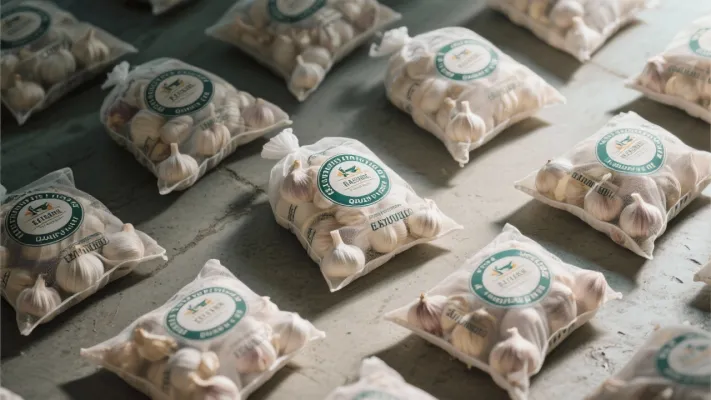
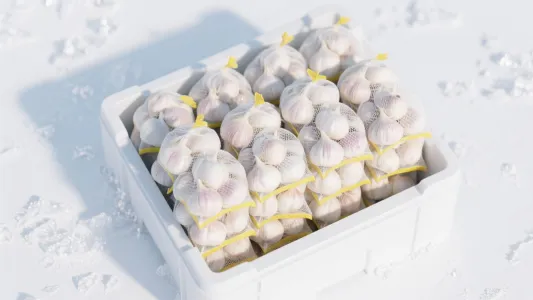
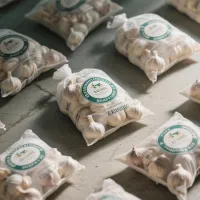
For exporters shipping garlic in bulk—especially to European markets—the biggest challenge isn’t just compliance or customs—it’s loss prevention during transit. Traditional woven bags often lead to mold, bruising, and uneven stacking, costing up to 25% of total shipment value. Here's how a simple shift to 10kg mesh-bag packaging, combined with smart cold chain execution, can reduce spoilage by over 70%, improve space utilization by 30%, and deliver measurable ROI.
A recent EU import audit revealed that 43% of garlic shipments from Asia experienced mold damage due to poor airflow in traditional jute or PP woven sacks. These materials trap moisture, especially when stored at 8–12°C—a common temperature range for sea freight. In contrast, our 10kg netted bag design allows for consistent air circulation around each clove, reducing internal humidity buildup and preventing microbial growth.
| Packaging Type | Avg. Mold Rate (Post-Transit) | Stacking Efficiency | Carbon Footprint per Ton |
|---|---|---|---|
| Woven Bag (50kg) | ~22% | Low (max 1.2m³/ton) | High (non-recyclable) |
| Mesh Bag (10kg) | ~6% | High (up to 1.8m³/ton) | Low (recyclable & reusable) |
The real power lies not just in the bag—but in how it’s handled. At our facility in Yantai, we now use temperature-controlled pallet racking (set at 10°C ±1) and load containers using a “bottom-up” stacking method where each 10kg bag is placed vertically, allowing airflow between layers. This reduces physical stress on individual cloves while enabling better cooling uniformity inside the container.
We also integrate IoT sensors into the first and last rows of every pallet to monitor real-time temperature and humidity. When deviations exceed thresholds (e.g., >12°C or <80% RH), alerts trigger immediate corrective actions—from adjusting refrigeration settings to rerouting shipments if necessary.
This approach isn’t just about efficiency—it’s about responsibility. By cutting waste by 70%, you’re also lowering your carbon footprint per kilogram shipped, aligning with EU Green Deal standards and enhancing buyer trust.
If you're tired of losing margins to preventable spoilage—or want to future-proof your export operations—we’ve compiled a detailed “Cold Chain Packaging Playbook” based on over 50 successful shipments to Germany, Italy, and the Netherlands.
Download the Free Cold Chain Packaging HandbookThis guide includes step-by-step visuals for proper pallet stacking, temperature logging templates, and supplier vetting checklists used by top-tier exporters.
 344
|
344
|
 low temperature garlic storage
garlic shelf life extension
cold chain management for garlic
breathable mesh packaging for garlic
garlic quality preservation
low temperature garlic storage
garlic shelf life extension
cold chain management for garlic
breathable mesh packaging for garlic
garlic quality preservation
_(2).jpg?x-oss-process=image/resize,h_300,m_lfit/format,webp) 442
|
premium grade A white garlic
European white garlic market
foodservice garlic procurement
white garlic packaging and storage
garlic marketing strategies
442
|
premium grade A white garlic
European white garlic market
foodservice garlic procurement
white garlic packaging and storage
garlic marketing strategies
 69
|
fresh garlic selection
garlic storage techniques
export garlic procurement
garlic freshness preservation
agricultural product packaging
69
|
fresh garlic selection
garlic storage techniques
export garlic procurement
garlic freshness preservation
agricultural product packaging
 144
|
garlic transportation packaging
breathable mesh bag for garlic
cold chain logistics for produce
mold prevention in garlic
agricultural packaging solutions
144
|
garlic transportation packaging
breathable mesh bag for garlic
cold chain logistics for produce
mold prevention in garlic
agricultural packaging solutions
 416
|
International garlic application
Red and purple garlic cooking techniques
Garlic variety flavors
Garlic packaging advantages
Chef's garlic selection guide
416
|
International garlic application
Red and purple garlic cooking techniques
Garlic variety flavors
Garlic packaging advantages
Chef's garlic selection guide

.png?x-oss-process=image/resize,h_600,m_lfit/format,webp)






.png?x-oss-process=image/resize,h_200,m_lfit/format,webp)





 TikTok
 Facebook